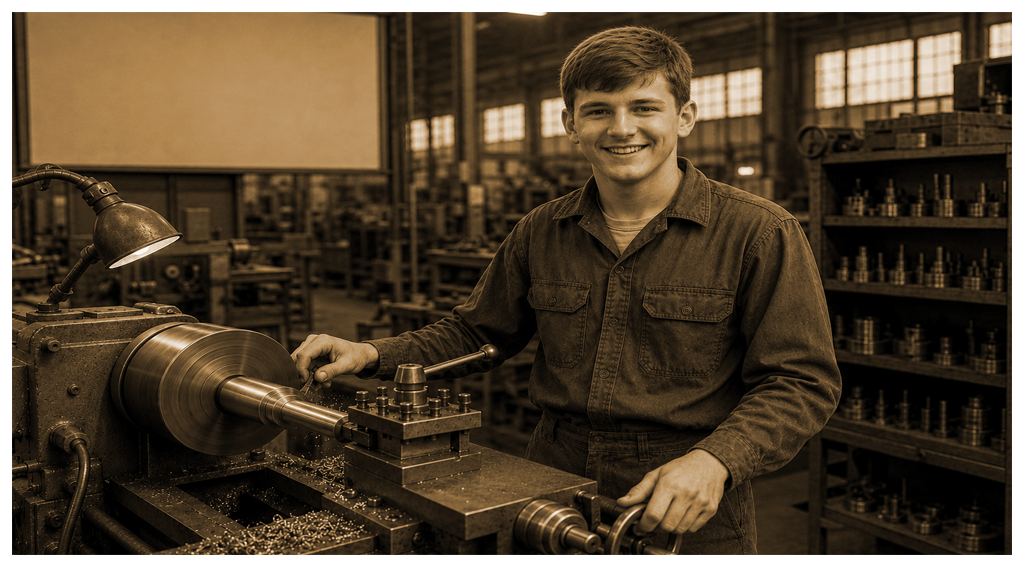
My wife could not drive the Porsche and regarded it as impractical. Her father, a machinist by trade, believed a young man should have a real job, preferably one that came with steady pay, benefits and enough predictability to satisfy sensible people.
Artists, sign painters and pin stripers did not fit comfortably into his definition of sensible.
After considerable encouragement from my in-laws and wife, I reluctantly agreed that perhaps they knew something I did not. This would not be the last time I accepted advice that sounded wise at the moment.
My father-in-law arranged a machinist trainee position for me at Harvey Aluminum. The company was involved in manufacturing components for the military, including parts for the Davy Crockett missile system. To a young man, it seemed important work and I was proud to be a part of it.
I was assigned to assist Mr. Ernie Pugh, an experienced machinist responsible for straightening missile tubes. The work required skill, patience and precision. Mr. Pugh knew his trade well, and I was eager to learn from him.
Then tragedy struck.
Shortly after I began working there, Mr. Pugh was killed while straightening one of the tubes. It was a sobering introduction to industrial work. Until then, I had viewed the factory as a place of steady employment and opportunity. Suddenly it became clear that heavy machinery had very little concern for a man's plans.
The company eventually entrusted me with responsibilities connected to the same operation. At the time I viewed this as a sign of confidence and took considerable pride in the assignment.
A few months later, the factory delivered its own lesson.
A machined part slipped from a forklift and came down on my right hand. In an instant, my first two fingers were nearly amputated. One moment I was thinking about work. The next I was thinking about whether I would ever use my hand properly again.
Several surgeries followed.
Then came months of recovery.
Then more waiting.
A year later I regained movement in the damaged fingers, but they were permanently deformed. The hand worked, but not the way it once had.
It was enough to end my pin striping career.
The steady hand required to pull a perfect line across a car or signboard was gone. Years spent learning lettering, striping and artistic techniques suddenly belonged to the past.
Looking back, it was one of life's first major lessons in how quickly circumstances can change. One day I was painting custom work and driving a Porsche. The next I was learning that careers, talents and plans can disappear without warning.
At eighteen, I thought I was choosing a safer future.
Life, however, had other ideas.